Stories from the Passenger Seat by Kimberly Golchin
My father served in Iran during the late 1970s, a turbulent time in Iran’s history. The country was changing quickly under Shah Mohammad Reza Pahlavi’s rule. Western influence had modernized cities, but political unrest and inequality simmered beneath the surface. Every young man was expected to serve, and my father was assigned to the war as a driver. He wasn’t a general or strategist but the person who made sure people and supplies reached their destination. While soldiers trained with weapons, he trained with patience, navigating rough roads, unpredictable weather, and long hours behind the wheel. Though he wasn’t on the front lines of a war, he still carried the pressure of duty in every mile he drove.
Sometimes I try to picture a single day of his service. The sun rises pale and slow over the mountains of Tehran. My father stands by a faded truck in the dust and heat. He climbs into the driver’s seat, starts the engine, and the noise breaks the early morning quiet. Perhaps he drives an officer across the city, or heads toward a rural post where soldiers wait for supplies. The road stretched out, new dust, new thoughts about home. There might have been moments of fear, rumors of protest, whispers of change, uncertainty of what the future would bring.
As the decade turned, Iran changed forever. The Revolution of 1979 reshaped its government, its values, and the lives of those who had served under the Shah. My father never spoke details of the time he served, but I always sensed a mixture of pride and pain. I think about how strange it must have felt to serve a system that soon disappeared, and to wear a uniform that suddenly meant something different. For him, his service wasn’t about politics. It was about loyalty to his country and to the people he was responsible for, no matter who sat in power. He was a driver, not a fighter, but in his own quiet way he represented endurance. The kind that survives revolutions and outlasts ideologies.
When I imagine him behind the wheel, I see more than a soldier. I see the values that shaped our family: Perseverance, humility, and quiet strength. Driving may seem ordinary, but in his world it meant protection, trust and steadiness. Evey trip demanded awareness and discipline, and every safe arrival was its own small victory. The same patience carried on to build a new life in a new country, learning a new language and starting over from nothing. The discipline of the military became the discipline of fatherhood, and I am one of the passengers who benefited from his lessons.
When my father moved to America, it was as if he had started a new journey on an unfamiliar road. He traded dusty streets of Iran for the freedom that America promises. He attended college and became and engineer. Along his new road, he met my mother. She became his new compass, helping him navigate a new country. Together they built a home that blended two worlds, his Persian roots and her American warmth. They filled a home with love, laughter, and second chances. I am one of the 8 children they had, and though he rarely spoke of his upbringing in another country, he loved his life here in America.
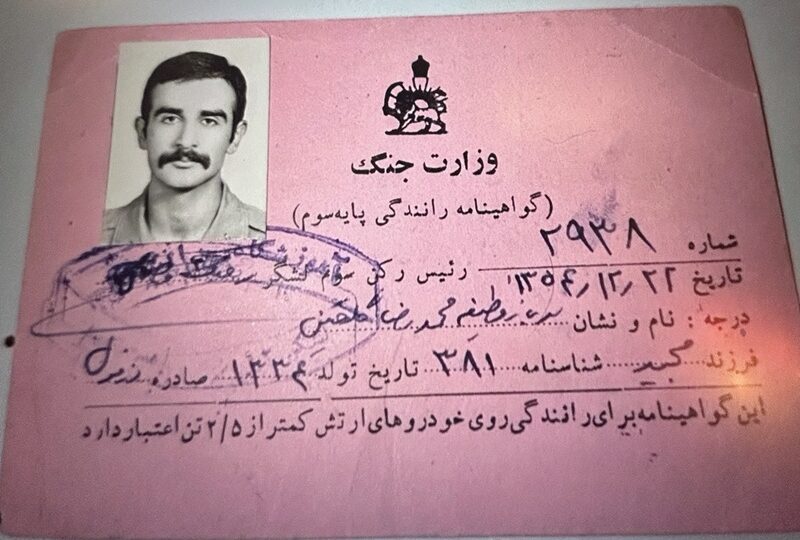
Now my father’s pink military identification card is tucked away in a photo album, worn and soft with age. The ink has faded, but the meaning to me hasn’t. When I look at it, I don’t see politics or war, I see resilience. It reminds me that strength can be quiet. That the people who keep the world moving are not always the ones who make speeches or lead armies. Some serve by driving forward, mile after mile, even when the destination is uncertain. My father’s past teaches me that courage doesn’t have to be loud. Sometimes it hums steadily, like an engine on a long road home.